What Is an EV Charger for Business?
An EV charger for business is charging equipment installed at a workplace, shop, hotel, fleet depot, or other commercial property. It lets employees, customers, guests, or fleet vehicles recharge while parked. The setup may include a single wall-mounted unit or several networked chargers with access controls and usage reporting. Some sites offer charging as a customer amenity; others use it to support daily vehicle operations. The right choice depends on parking patterns, vehicle types, electrical capacity, and how long vehicles typically stay. It is not just a plug on a wall.
Ev Chargers For Business can help a company meet practical charging needs and make better use of its parking area. For example, a hotel might install chargers near overnight guest spaces, while a delivery depot may need several units ready before morning routes. Site assessments matter. A qualified installer can review the electrical supply, cable routes, and likely demand before equipment is selected. Businesses should also consider payment options, network reliability, maintenance, and clear instructions for drivers. Small details count: a blocked charging bay or confusing screen can frustrate users. Costs and returns vary, so avoid assuming every installation will pay for itself quickly. That part deserves a closer look. A useful plan starts with real parking and charging habits, then grows as demand becomes clearer.
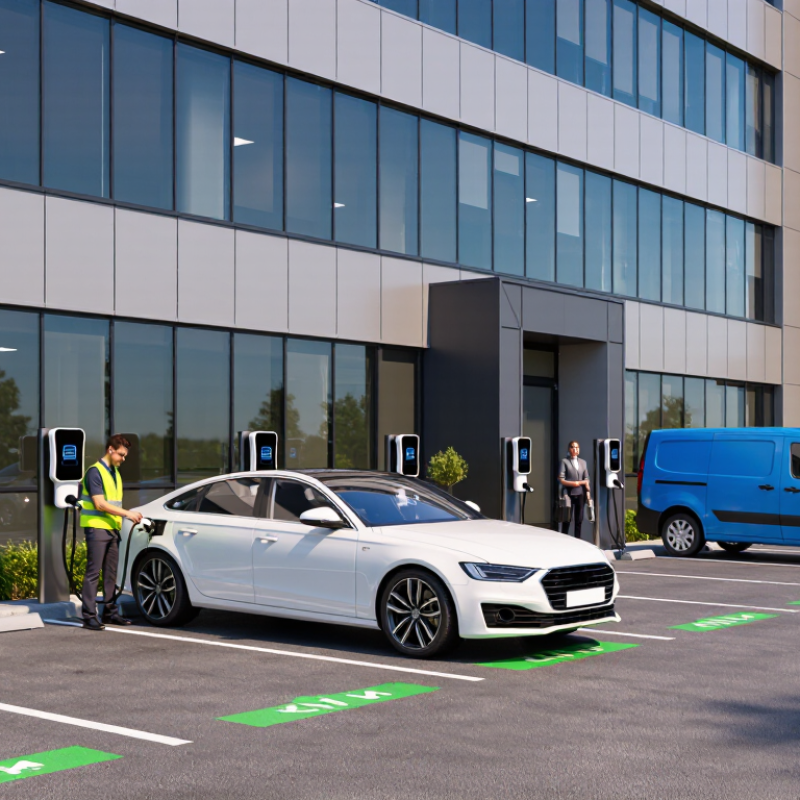
What Defines a Business EV Charger? AC and DC Equipment Explained
A business EV charger is defined by its job, not just its casing. It serves a workplace, fleet yard, hotel, or retail car park, where charging time and daily vehicle use shape the choice. AC equipment supplies alternating current; the vehicle’s onboard charger converts it for the battery. This usually suits vehicles parked for hours. DC equipment converts power inside the charging unit and sends it directly to the battery. It can support faster top-ups, but often requires more electrical capacity and site planning.
The International Energy Agency’s Global EV Outlook 2024 reports that public charging points passed four million worldwide in 2023. Public fast-charging points grew by 55% that year, exceeding 500,000. That matters. The figures show rising demand, but they do not mean every business needs DC equipment. A staff car park with long dwell times may work well with AC chargers. A fleet turning vehicles around quickly may need DC, if the local grid can support it.
A sound specification looks beyond kilowatts. Check parking duration, concurrent charging needs, electrical capacity, weather exposure, and how users will access the equipment. Load management can help share available power across several sockets. Still, a neat spreadsheet can miss real arrival patterns. Reviewing actual site use after installation may reveal that the original charger mix needs adjustment.
How Do Level 2 (3.3–19.2 kW) and DC Fast Chargers (50–350 kW) Compare?
Level 2 chargers, rated at 3.3–19.2 kW, suit workplaces, hotels, and retail sites where vehicles stay parked for hours. The U.S. Department of Energy’s Alternative Fuels Data Center reports that Level 2 charging typically adds about 10–20 miles of range per hour. That is often enough during a work shift. Installation may also be simpler than high-power charging, but a site’s electrical capacity still matters. A row of chargers can strain a service panel if many vehicles charge together.
DC fast chargers, rated at 50–350 kW, serve drivers who need a quick stop and businesses with frequent vehicle turnover. The same DOE resource estimates roughly 100–200 miles of range in 30 minutes, depending on the vehicle and conditions. Faster is not always better. A vehicle may accept less power than the charger can provide, especially as its battery fills or temperatures change. NREL’s 2023 National Plug-In Electric Vehicle Infrastructure Analysis also emphasizes matching charging access to travel patterns. For a business, parking time, utility costs, and local demand matter as much as peak kilowatts. The simple comparison is useful, but incomplete. A charger’s rated power is not a promise of charging speed.
What Is an EV Charger for Business?
Typical rated power ranges: Level 2 chargers deliver 3.3–19.2 kW, while DC fast chargers deliver 50–350 kW.
The bars show charger power ranges on a logarithmic scale so both categories are easy to compare. Actual charging speed depends on the vehicle’s charging capability, battery conditions, and site electrical capacity.
Which Business Sites Suit Workplace, Fleet, Retail, or Public Charging?
Workplace charging suits offices, hospitals, and campuses where vehicles remain parked for several hours. Employees can plug in after arriving, then charge during meetings or shifts. A site review should consider parking patterns, electrical capacity, and how many people need access. Small details matter. A charger near a staff entrance may be more useful than one beside a rarely used visitor space.
Fleet depots need a different setup. Delivery vans, service vehicles, and municipal cars often follow predictable routes and return to the same yard. Charging equipment should match vehicle schedules, parking layout, and the time available between shifts. Operators may need several charging points, but adding them before checking the electrical supply can create costly redesigns. A qualified electrical assessment helps identify practical limits.
Retail centers, hotels, and public parking sites can suit customer-facing charging. Shoppers may stay for an hour, while hotel guests may park overnight; those habits affect charger speed and placement. Clear signs, accessible parking routes, lighting, and simple payment options can reduce friction. Yet demand is easy to overestimate. A few busy weekends do not always reflect year-round use, so tracking actual sessions can guide gradual expansion.
How Do Load Management and Grid Capacity Shape Multi-Port Charging?
A business EV charger is equipment that lets employees, customers, or fleet vehicles charge on site. With several charging ports, the key question is not simply how many vehicles can plug in. It is how much power the building can provide at the same time. Load management shares available power across active chargers and can adjust output as vehicles arrive or leave. For example, a site might have six ports but reserve more power for a delivery van due to depart soon. The remaining vehicles can charge more slowly. That matters.
Grid capacity sets the ceiling. A property with a limited electrical service may not support every charger running at full output while kitchen equipment, lifts, or heating systems are operating. A qualified electrical assessment can review service capacity, peak demand, wiring, and likely charging patterns before installation. Smart controls may help avoid unnecessary peaks, but they cannot create extra grid capacity. If vehicles all need rapid charging during the same short window, managed charging alone may not meet the schedule. Forecasts are imperfect, too. Real usage can differ from a spreadsheet, so businesses should monitor demand after installation and adjust charging rules as patterns become clearer.
What Is an EV Charger for Business? - How Do Load Management and Grid Capacity Shape Multi-Port Charging?
Illustrative examples only. Actual charging capacity depends on site electrical design, charger configuration, vehicle limits, and applicable codes.
| Business site scenario |
Charging ports |
Maximum output per port |
Combined rated output |
Charging power budget |
Example with every port in use |
Grid-capacity implication |
| Small workplace |
4 |
7.2 kW |
28.8 kW |
30 kW |
Up to 7.2 kW per vehicle; 28.8 kW total |
The example budget can support all ports at their rated output, with 1.2 kW left within the stated budget. |
| Office with a shared power limit |
4 |
11 kW |
44 kW |
24 kW |
An equal-share example is 6 kW per vehicle; the system keeps total charging at or below 24 kW. |
Load management prevents the chargers from drawing their combined 44 kW rated output at once. |
| Fleet parking area |
6 |
7.2 kW |
43.2 kW |
18 kW |
An equal-share example is 3 kW per vehicle while all six vehicles are charging. |
A shared limit can allow more ports to be installed than the available power would support at full output simultaneously. |
| Commercial site with higher available capacity |
4 |
11 kW |
44 kW |
40 kW |
An equal-share example is 10 kW per vehicle when all four ports are active. |
The shared limit is 4 kW below the combined rated output, so charging must be capped or staggered during full use. |
| Site with limited electrical headroom |
4 |
7.2 kW |
28.8 kW |
12 kW |
An equal-share example is 3 kW per vehicle when all four ports are in use. |
A lower charging budget may make managed charging useful, but the site limit must be verified by a qualified electrical professional. |
How to read the figures: kW measures the rate of power delivery. The charging power budget is the example amount allocated to EV charging after accounting for other site loads; it is not the building’s total service capacity. Load management can distribute that budget among active ports or schedule charging over time. Actual vehicle charging may be lower because of vehicle limits, battery state, or other operating conditions.
What Signals Market Demand? Global Public Chargers Exceeded 4 Million in 2023
A business EV charger is charging equipment installed at a workplace, hotel, retail site, or fleet depot. Its value depends on more than hardware: drivers need convenient access, clear pricing, and reliable uptime. The market signal is growing. The International Energy Agency’s Global EV Outlook 2024 reports that public charging points worldwide exceeded 4 million in 2023, up more than 40% from the previous year. That matters. More chargers suggest rising investment and broader access, though totals alone do not show how busy each site is.
The IEA report also records 55% growth in public fast chargers during 2023. For businesses, that points to demand for quicker charging where drivers park briefly, such as shops or service stops. Workplaces and hotels may suit slower units, since vehicles often stay parked for hours. But demand is uneven. A charger beside an empty car park may see little use, while a modest site near busy destinations could serve more drivers. The figures are a strong signal, not a guarantee of returns.
Tips: Check local EV registrations, nearby public chargers, parking patterns, and likely dwell time before choosing charger speed or quantity. Track use after installation, too. Early estimates can be wrong; review real session data and adjust pricing or access as needed.



 Phone
 Send Email
 whatsapp
 Facebook
 Youtube